
 New York 20°C
Procrastination is one of the most common challenges in modern daily life, especially when tasks require focus, consistency, or long-term decision-making. It is not simply a lack of discipline, but rather a mental pattern that leads people to delay actions even when they know those actions are important. Understanding this behavior is the first step toward making real and lasting change.
When we talk about how to stop procrastinating, we are not referring to magic solutions or overly complex techniques, but rather small behavioral adjustments that reduce the initial resistance to starting a task. In this article, you will find practical and actionable strategies you can apply from the very beginning, designed to help you regain control over your time and attention without relying on motivation.
You might also be interested in reading: 6 Quick breakfast recipes

Why You Really Procrastinate
Procrastination is not usually related to laziness, but rather to how the brain reacts to tasks it perceives as uncomfortable, complex, or emotionally demanding. In many cases, the issue is not a lack of time, but a tendency to avoid feelings such as stress, uncertainty, or pressure. That is why understanding the origin of this behavior is key before applying any technique on how to stop procrastinating effectively. This approach allows you to change the root of the problem, not just the symptoms.
It’s Not a Lack of Time, It’s Mental Resistance
Procrastination is rarely related to a real lack of available time, but rather to the mental resistance that appears when a task requires sustained effort or creates discomfort. The brain tends to avoid what it perceives as difficult or not immediately rewarding, even if it is important in the long term. This avoidance mechanism is what truly blocks the start of action.
When you understand this pattern, you can stop interpreting it as a time management issue and start seeing it as a matter of mental regulation. Shifting this perspective is a key part of how to stop procrastinating, because it allows you to act on the real cause of the behavior instead of only its visible symptoms.
The Cycle of Avoiding, Relief, and Repetition
Procrastination works like an automatic cycle that reinforces itself with every repetition. First, you avoid the task; then you feel immediate relief because the pressure of the moment is reduced, but later guilt or stress appears due to the lack of progress. This pattern strengthens avoidance behavior because the brain learns that postponing creates quick relief.
Over time, this cycle becomes stronger and harder to break if it is not consciously interrupted. The key is to detect the initial moment of avoidance and act before temporary relief turns into a habit. Breaking this pattern is essential to truly understand how to stop procrastinating in an effective and lasting way.
You might also be interested in reading: How to Get Ready for Winter in New York City 2026

7 Tips to Stop Procrastinating
Applying clear and simple strategies is the most effective way to change the habit of postponing tasks in daily life. These 7 tips are designed to directly address the main mental blocks that lead to inaction, such as difficulty getting started, cognitive overload, and constant distraction. The goal is not to increase motivation, but to reduce friction so you can take action immediately when resistance appears. This practical approach is a key part of how to stop procrastinating, as it allows small changes to turn into sustainable results.
Tip 1: Apply the 5-Minute Rule
One of the main blocks when it comes to working or completing important tasks is not the difficulty itself, but the initial resistance to starting. The 5-minute rule is based on a simple behavioral principle: reducing the mental pressure associated with beginning an activity. Instead of committing to finishing an entire task, you only commit to working on it for five minutes, which removes the feeling of excessive burden.
This approach works because the human brain tends to overestimate the effort required before starting, which triggers automatic avoidance. However, once action begins, the perception of effort decreases, and you are more likely to continue naturally. Consistently applying this technique is one of the most effective ways in how to stop procrastinating, as it directly targets the most critical friction point: getting started.
Tip 2: Break the Task into Micro-Actions
Large tasks often trigger procrastination because the brain interprets them as complex or hard-to-control threats. When an activity lacks a clear structure, the mind becomes overwhelmed and tends to avoid it completely. Breaking the task into micro-actions helps transform that mental block into small, concrete, and easy-to-execute steps.
For example, instead of aiming to “finish a project,” you can reduce it to actions like opening a file, writing a basic outline, or gathering initial information. This shift reduces cognitive load and helps the brain perceive immediate progress, which creates internal motivation to continue. This method is essential in any process of how to stop procrastinating, because it turns overwhelming tasks into simple sequences of action.
Tip 3: Reduce Decisions Before Starting
One of the least visible but most important factors in procrastination is decision fatigue. Every time you have to decide where to start, what to do first, or how to structure a task, you are consuming mental energy. When this energy runs low, the brain chooses to avoid the task instead of facing more decisions, which reinforces the habit of postponing.
To reduce this problem, it is essential to eliminate decision-making at the moment of execution. This is achieved by planning in advance which task you will complete, in what order, and with which resources. Even preparing your workspace beforehand can make a significant difference. This type of strategy is essential in how to stop procrastinating, because it reduces mental friction before any action begins.
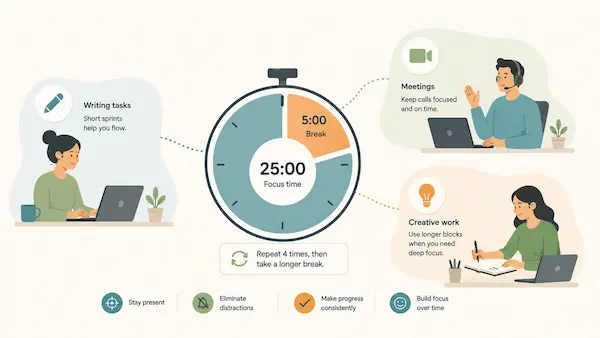
Tip 4: Use the Pomodoro Technique Strategically
The Pomodoro Technique is one of the most widely used tools to improve focus, but its effectiveness depends on how it is applied. It consists of working in defined time blocks, usually 25 minutes, followed by short breaks. This system helps reduce mental fatigue and improves the ability to maintain focus on specific tasks without constant interruptions.
However, its real value is not just in the timing, but in creating structure and clear boundaries for attention. By dividing work into controlled intervals, the brain perceives the task as more manageable and less overwhelming. Implementing this method consistently contributes directly to how to stop procrastinating, as it turns work into short cycles of action and recovery, preventing mental saturation.
Tip 5: Control Distractions Before You Start
One of the most decisive factors in modern procrastination is not a lack of time, but how easily the environment interrupts attention. Constant notifications, open social media platforms, and multiple digital stimuli create cognitive fragmentation that makes it difficult to stay focused even on simple tasks. The problem becomes worse when the brain anticipates these interruptions before starting, which triggers an automatic tendency to delay action.
To counter this, it is necessary to design an environment that minimizes sources of distraction before beginning any important activity. This includes actions such as turning off notifications, organizing your workspace, closing unnecessary apps, and creating a clean visual environment. By doing this, you reduce the mental load associated with continuous self-control. This type of preparation is essential in how to stop procrastinating, as it protects attention from the very beginning and reduces reliance on willpower during execution.
Tip 6: Create Immediate Rewards After Each Work Block
The human brain is naturally wired to prioritize immediate rewards over long-term benefits, which explains why important tasks are often postponed in favor of more pleasurable activities. When a task does not offer visible short-term gratification, perceived effort increases and avoidance behavior is triggered. This imbalance between effort and reward is one of the most common causes of daily procrastination.
To correct this pattern, it is necessary to introduce small and consistent rewards after each completed work block. These rewards do not need to be big, but they should be immediate and clear, such as taking a short break, enjoying something you like, or doing a relaxing activity. The key is to create a direct association between action and reward in order to retrain behavior. Applying this principle consistently is crucial in how to stop procrastinating, because it helps the brain link effort with positive short-term outcomes.
Tip 7: Start With the Easiest Task of the Day
One of the most effective ways to break the cycle of inaction is to begin the day with a simple, quick, and low cognitive-effort task. This works because the brain needs an “activation entry point” that reduces initial resistance to work. When you start with something easy, it creates an immediate sense of progress that helps lower the emotional burden associated with more complex tasks.
This principle is based on building momentum, where a small initial action triggers a chain of more productive behavior. It is not about avoiding difficult tasks, but about preparing your mental system to face them with less resistance. Applying this approach consistently is key in how to stop procrastinating, because it transforms the start of the day into an activation point rather than a mental block.
How to Maintain the Habit of Stopping Procrastination
Maintaining the habit of how to stop procrastinating is not a process that depends on daily motivation, but rather on creating simple systems that reduce friction when it comes time to act. In most cases, people make initial progress but abandon it because they try to sustain overly demanding or unrealistic changes over time. The key is to design a flexible system that allows progress even on days of low energy or focus.
Another important point is understanding that the habit is not built through isolated big actions, but through the consistent repetition of small correct decisions. This means accepting that there will be days when progress is minimal, but it is still progress. This gradual approach is essential in how to stop procrastinating, because it turns change into a sustainable process rather than a one-time demand that leads to frustration or abandonment.
Consistency Is More Important Than Perfection
One of the most common mistakes when trying to improve productivity or eliminate procrastination is associating success with perfect execution of every task. This mindset creates unnecessary internal pressure that, paradoxically, increases the tendency to delay. When a person feels they must do everything perfectly from the start, fear of mistakes blocks action and reinforces avoidance behavior.
Instead, when consistency is prioritized, the focus shifts to habit repetition rather than immediate results. This means accepting that some actions will be incomplete, slow, or even imperfect, but still valuable within the overall process. This mindset is fundamental in how to stop procrastinating, because it removes extreme pressure and allows progress to be sustained over time without interruptions caused by frustration or excessive self-demand.
What to Do When You Start Procrastinating Again
Relapsing into procrastination should not be interpreted as a failure of the process, but as a natural part of human behavior. The brain tends to return to familiar patterns, especially when facing stress, fatigue, or complex tasks. Therefore, the most important thing is not to avoid relapse completely, but to learn how to respond quickly and consciously when it happens.
The most effective strategy in these cases is to immediately reduce the scale of action, instead of trying to forcefully regain full momentum. This can be done with a minimal task that reactivates movement, such as working for a few minutes or completing a very simple step. This approach prevents a pause from turning into total abandonment and is key in how to stop procrastinating, because it allows you to regain control without needing to restart the entire process from zero.

When You Start Taking Action Without Procrastinating
Stopping procrastination is not a sudden change, but the result of small, repeated decisions that gradually reshape how you approach your daily tasks. Throughout this process, the most important goal is not to completely eliminate the tendency to procrastinate, but to learn to recognize it and act despite it. Each of the strategies presented works as a support point to reduce initial resistance and make it easier to start acting in key moments. Over time, these adjustments become a natural part of your routine and no longer require constant conscious effort.
When you begin to apply these changes consistently, you will notice that the feeling of being stuck decreases and it becomes easier to move forward even with tasks you used to avoid. It is not about perfection, but about steady progress built day by day through simple yet intentional actions. Understanding this process is essential in how to stop procrastinating, because it allows you to transform your relationship with time, discipline, and execution, making action feel less like a burden and more like a natural automatic behavior.