
 New York 11°C

Running a storefront in New York City means balancing security, appearance, and everyday convenience. Whether a business operates in Manhattan, Brooklyn, Queens, the Bronx, or Staten Island, protecting its entrance is an important part of maintaining a safe and functional commercial property.
Choosing the right security gate involves more than selecting a strong metal barrier. Business owners must consider visibility, entrance dimensions, operating mechanisms, and how frequently employees need access to the premises. A gate that works well for a small boutique may not be suitable for a busy restaurant or a warehouse receiving regular deliveries.
Understanding the available options can help NYC business owners invest in storefront protection without sacrificing accessibility, customer experience, or operational efficiency.
Understand the security needs of your NYC storefront
Every commercial property has different security requirements. Before comparing gate designs, business owners should evaluate the location, business activity, and potential vulnerabilities of their storefront.
For example, a jewelry store displaying valuable merchandise may prioritize additional physical protection, while a clothing boutique might prefer a gate that allows customers to see its window displays after closing.
Evaluate the location and surrounding environment
A storefront’s surroundings influence the type of security it needs. Businesses located along busy commercial corridors may have different concerns from establishments operating on quieter residential streets.
Consider whether the property has large glass windows, recessed entrances, exposed locks, or multiple access points. These features can influence the gate’s design and placement.
The objective is to identify realistic security risks and choose a system that addresses them without creating unnecessary complications.
Consider the type of business
Retail stores, restaurants, pharmacies, and service providers use their entrances differently. A restaurant may require late-night employee access, while a retail store may only open and close its gate twice daily.
Businesses handling frequent deliveries may need wider openings and mechanisms capable of supporting repeated operation.
By understanding these differences, owners can narrow their options before requesting installation estimates.
Compare security gate types based on protection and visibility
One of the most important decisions when selecting commercial security gates is choosing between solid, perforated, and open-grille designs.
Each option offers different advantages depending on privacy requirements, desired visibility, and the storefront’s appearance.
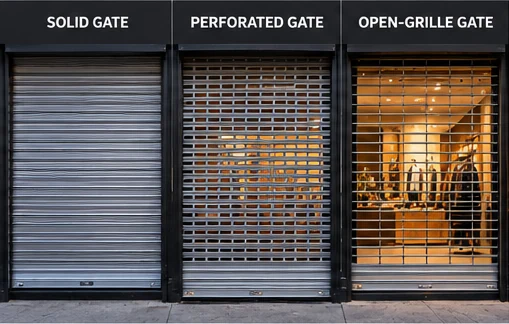
Solid rolling gates for additional privacy
Solid rolling gates create a continuous physical barrier across a commercial entrance. Their enclosed construction limits direct visibility into the premises when the gate is closed.
These gates may appeal to businesses that prioritize privacy or want to conceal merchandise and equipment outside operating hours.
However, solid gates can also make storefronts appear completely closed off. Owners should consider how this affects their exterior presentation, lighting, and overall commercial environment.
Perforated gates for balanced visibility
Perforated security gates contain openings in the metal surface, allowing partial visibility while maintaining a physical barrier.
This design can work particularly well for retail businesses that want some visibility into their premises after closing.
Perforated gates also offer a compromise between an enclosed appearance and a more open storefront design. The size and arrangement of the perforations influence visibility and airflow.
Open-grille gates for window displays
Open-grille security gates feature a more open structure that allows pedestrians to see through the barrier.
They can be useful for boutiques, showrooms, and stores where attractive window displays contribute to customer interest.
Although open-grille gates provide a visible physical boundary, their security performance depends on construction quality, locking mechanisms, materials, and installation.
Business owners should evaluate these characteristics rather than assuming that one gate design automatically provides better protection.
Measure storefront dimensions before choosing a gate
Accurate measurements are essential for installing a security gate that fits correctly and operates reliably.
New York City storefronts vary considerably in size and configuration. Older commercial buildings may have unusual entrance dimensions, architectural details, or limited overhead clearance.
Choosing a standard gate without evaluating these conditions can create installation difficulties or affect daily operation.
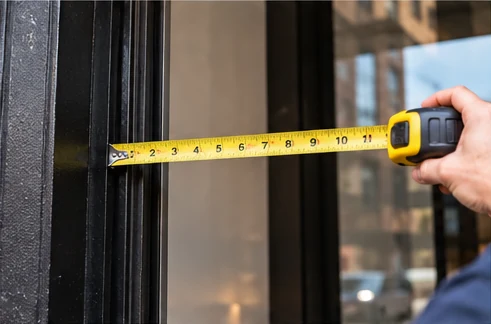
Measure the entrance width and height
The first step is determining the dimensions of the opening that requires protection.
Installers generally need to evaluate:
- The clear width and height of the entrance.
- Available overhead space for the rolling mechanism.
- Wall conditions and potential mounting locations.
- Space for side tracks and supporting components.
- Obstructions such as signage, lighting, and architectural features.
These measurements help determine whether a standard design is suitable or custom fabrication is necessary.
Evaluate the available installation space
A rolling gate requires adequate space for its curtain, guides, and operating mechanism.
Some storefronts have limited overhead clearance because of signs, structural beams, or decorative building elements.
The surrounding structure must also be suitable for supporting the gate and its hardware.
A professional site assessment can identify these challenges before fabrication begins, reducing the likelihood of costly modifications during installation.
Choose between manual and motorized security gates
The operating mechanism affects convenience, maintenance requirements, and the overall experience of using a commercial entrance.
Both manual and motorized gates can provide effective storefront protection when properly selected and maintained.
Manual gates for smaller businesses
Manual rolling gates are operated without an electric motor. Depending on their design, they may use a spring-assisted mechanism to make lifting and lowering easier.
They can be practical for smaller entrances where the gate is operated only a few times per day.
However, owners should consider the gate’s weight, ease of operation, and the physical capabilities of employees responsible for opening and closing it.
A manual system should never be so difficult to operate that staff members must struggle to use it safely.
Motorized gates for frequent operation
Motorized security gates use an electric operating system to raise and lower the barrier.
They may be particularly useful for businesses with large entrances, frequent access requirements, or employees who need to operate the gate regularly.
Motorized systems can also offer different control options, depending on the equipment selected.
Before choosing automation, businesses should ask about emergency operation, power outages, safety devices, maintenance requirements, and how the system will function during normal business hours.
The best mechanism is one that supports daily operations without adding unnecessary complexity.
Match the security gate to daily business operations
A security gate should protect the property while supporting the way employees, customers, and delivery personnel use the building.
Choosing a system based only on its initial appearance can lead to operational inconveniences.
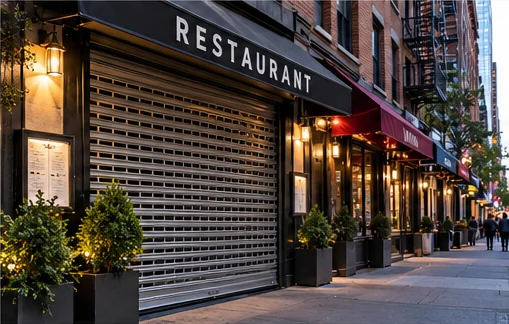
Retail stores and boutiques
Retail businesses often benefit from gate designs that balance security and visual appeal.
For stores with large display windows, perforated or open-grille options may help maintain visibility after closing.
The design should also complement the storefront’s overall appearance without interfering with signage or entrance accessibility.
Restaurants and food businesses
Restaurants may operate early in the morning or late at night, making dependable access particularly important.
Owners should consider employee schedules, delivery routines, cleaning procedures, and access to service entrances.
A gate that is easy to operate can help staff complete opening and closing procedures more efficiently.
Warehouses and commercial facilities
Properties that handle equipment or merchandise deliveries may require wider openings and durable operating components.
Frequent gate movement can place additional demands on mechanical parts, making appropriate equipment selection and preventive maintenance especially important.
For these facilities, operational reliability may be just as important as the appearance of the gate.
Understand NYC regulations and installation requirements
Before installing or replacing a storefront security gate, business owners should review applicable New York City requirements.
Building regulations, permitted installation methods, emergency exits, and historic preservation restrictions can influence the final design.
An important regulatory change occurred in June 2026, when New York City repealed the general requirement that certain business and mercantile security grilles provide at least 70% visibility from the sidewalk.
This means business owners can consider different visibility levels, although applicable permitting and building safety requirements remain in effect.
Properties located within designated historic districts or protected landmark buildings may face additional restrictions concerning gate placement, appearance, and architectural compatibility.
Business owners should consult the NYC Department of Buildings and, where relevant, the Landmarks Preservation Commission before proceeding.
Security gates must also be planned so they do not improperly obstruct required exits or interfere with emergency evacuation.
Work with experienced security gate installers
Selecting a gate is only one part of the process. Proper installation is equally important for dependable long-term performance.
A poorly fitted gate may become difficult to operate, create excessive noise, or develop alignment problems over time.
Professional installers can assess entrance measurements, mounting conditions, operating requirements, and the suitability of different materials.
For businesses evaluating Rolling gate installation in NYC, reviewing available installation, repair, maintenance, and custom fabrication services can help clarify which solutions are appropriate for their commercial property.
Before approving a project, owners should request a detailed estimate outlining the proposed gate type, operating mechanism, materials, installation scope, and any additional work required.
It is also useful to ask about future maintenance, replacement components, and the procedures for addressing unexpected operating problems.
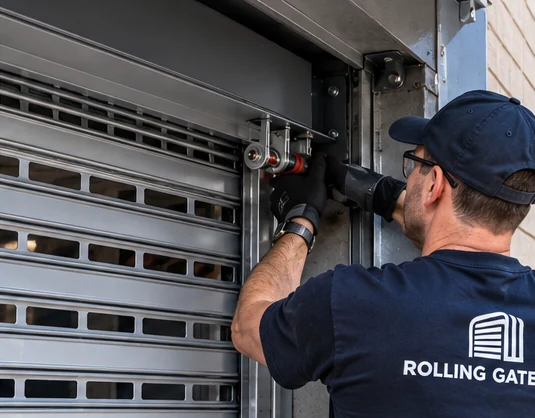
Plan for maintenance and long-term costs
The initial installation price should not be the only factor influencing a purchasing decision.
A commercial security gate is a mechanical system that experiences wear through regular use, exposure to weather, and repeated opening and closing.
Preventive maintenance can help identify worn components, lubrication needs, track obstructions, and alignment problems before they lead to more significant failures.
Business owners should also evaluate the availability of repairs and replacement parts.
A lower upfront price may not represent better long-term value if the system requires frequent repairs or causes operational disruptions.
When comparing estimates, consider durability, ease of maintenance, operating convenience, and suitability for the property’s specific needs.
Making the right security gate investment for your storefront
Choosing the right security gate for an NYC storefront requires a balance between physical protection, visibility, dimensions, and everyday business operations.
Solid gates offer privacy, perforated models provide partial visibility, and open-grille designs can help showcase retail displays. Meanwhile, manual and motorized mechanisms serve different operational needs.
Accurate measurements, compliance with applicable regulations, and professional installation are essential considerations before making a final decision.
By evaluating the storefront’s security requirements alongside its daily activities, New York City business owners can select a gate that protects their premises, supports reliable access, and remains practical for years to come.